Manufacturing Case · Hotels & Resorts · Lobby Furniture
Boutique Hotel — 54-Piece Custom Acrylic Furniture Program
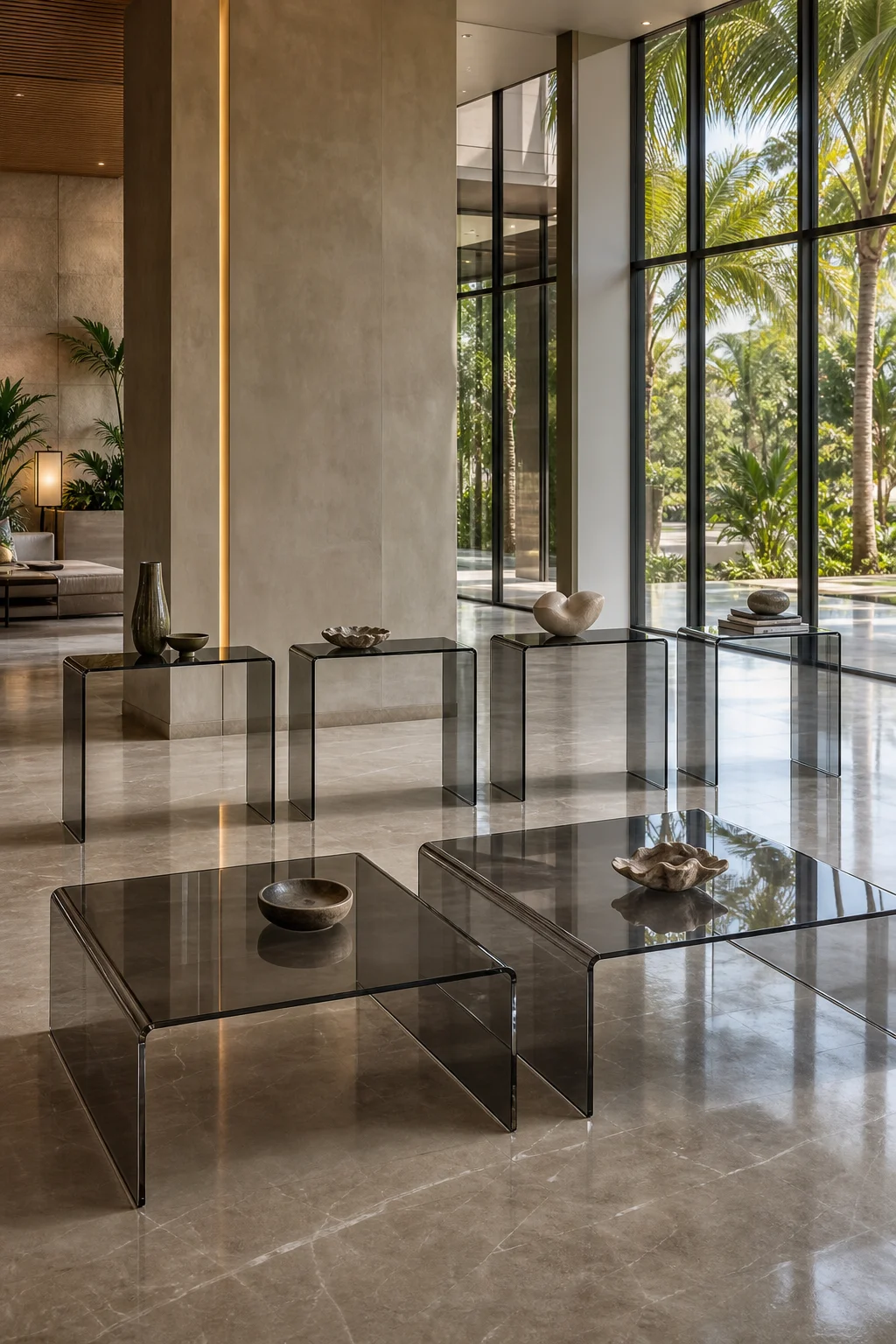
This 54-piece, 3-phase hotel furniture plan carries one engineering standard from lobby to poolside and guest rooms. The first six statement pieces set the controls: UV-stabilized 15 mm cast PMMA, waterfall edges, a sample-approved smoke tint, CNC routing, diamond polishing, and project-specific load and packing tests before bulk release.
- Program input · program pieces
- 54
- Program input · lobby · pool · rooms
- 3 phases
- Program input · tint target
- ΔE < 1.5
- Program input · production target
- 17–22 days
Key Takeaways
- UV-stabilized 15 mm cast PMMA holds clarity at 5+ years under sustained tropical sunlight + 8 hr/day lobby LED — standard cast yellows visibly at 18-24 months in the same environment.
- Custom smoke tint matched to hotel brand palette at ΔE < 1.5 across all 6 pieces — batch-mixed tint masterbatch from a single lot delivers consistency that per-piece tinting cannot match.
- Waterfall edge profile on all 4 console tables eliminates sharp edges in high-traffic lobby zones while creating the continuous-flow aesthetic that defines modern lobby furniture.
- 22-day production timeline (sample 5 days + production 17 days) beat the 35-day hotel opening deadline by 13 days, leaving buffer for freight + on-site installation.
The Challenge
The buyer managed procurement for a Southeast Asian boutique hotel brand opening their flagship property. The lobby was the first touchpoint — guests would see the furniture before they reached the front desk — and the design team had specified custom acrylic coffee tables and console tables in a coordinated smoke tint that matched their broader brand palette. Off-the-shelf acrylic furniture was out of the question: stock pieces ship in clear or black, not brand-specific smoke tints, and they come in standard dimensions that didn't fit the lobby's spatial plan.
Three constraints shaped the project. First, the tropical climate: sustained UV exposure through floor-to-ceiling lobby glass plus 8+ hours of LED ambient lighting daily would yellow standard cast acrylic within 18-24 months — unacceptable for a hotel that expects 5+ years between lobby refreshes. Second, foot traffic: the lobby would see 200+ guest passes per day, meaning every edge profile had to eliminate pinch points and sharp corners without compromising the clean-line aesthetic the design team wanted. Third, timeline: the hotel opening was 35 days out, and the furniture was the last major procurement item still unresolved.
The buyer had received quotes from two other fabricators. One offered 40-day lead times — too slow. The other could hit the timeline but proposed per-piece tinting (spraying each table individually), which the buyer's design team had already rejected after seeing a sample set where ΔE variation across 4 pieces was visually obvious at 2-meter viewing distance.
Our Approach
Four production decisions drove the project from approved design to FOB Shenzhen in 22 days.
15 mm UV-stabilized cast PMMA
Hotel lobby furniture takes abuse that retail display pieces don't — bags dropped on surfaces, daily cleaning, and sustained light exposure. This plan uses 15 mm UV-stabilized cast PMMA, subject to the material supplier’s data and the project’s exposure conditions. The thickness and full-size sample establish whether a 1200 × 600 mm coffee table span can meet the agreed load and deflection criteria without visible internal bracing.
Single-lot masterbatch tint for ΔE < 1.5 consistency
The buyer's design team had already rejected per-piece spray tinting from another fabricator. Our approach: batch-mix a single lot of smoke tint masterbatch — enough to cover all 6 pieces plus 15% overage for QC samples — from one pigment lot. This eliminates the lot-to-lot pigment variation that makes per-piece tinting visually inconsistent across a batch. We ran QC spectrophotometer readings on 3 sample chips before production and hit ΔE < 1.0 against the approved reference; the final 6 pieces all measured ΔE < 1.5 against each other, well inside the threshold for visual consistency at any viewing distance.
Waterfall edge profile
All 4 console tables received a waterfall edge — the acrylic sheet bends 90° from horizontal surface down to the floor in a single continuous curve, with no visible seam at the bend radius. This serves two purposes: it eliminates the sharp 90° edges that are a liability in high-traffic lobby zones, and it creates the continuous-flow visual that the design team specified. The coffee tables used a modified waterfall with a 50 mm radius at each end, maintaining the same design language at a different scale. CNC routing cut the profiles; diamond polishing brought the edge faces to optical clarity; solvent welding joined the waterfall bends with bond lines that disappear under the smoke tint.
Production timeline: 22 days
Sample phase ran 5 days — one coffee table sample and one console table sample, both at full scale in the production tint, shipped to the buyer's design team for sign-off. Production ran 17 days: substrate sourcing from a single UV-stabilized cast sheet lot (3 days), CNC routing + waterfall bending (5 days), diamond polishing all visible surfaces to 800-grit optical finish (4 days), solvent welding + assembly (3 days), tint-match QC + protective packaging (2 days). The 22-day total beat the 35-day opening deadline by 13 days, leaving comfortable buffer for 12-day ocean freight to the installation site. Full customization workflow details here.
Acceptance Plan and Modeled Outcome
For Phase 1, the acceptance plan checks tint under both natural daylight and the property’s actual LED ambient lighting, then records edge, joint, load, and surface condition before packing. That prevents a batch that looks consistent in factory lighting from drifting once installed.
A poolside phase can reuse the furniture family while changing the UV exposure, tint, edge profile, and packing assumptions. Existing CNC files and an approved material source shorten setup, but direct sun and outdoor handling still require a separate sample approval.
A guest-room phase extends the same control library to side tables and amenity trays. Room count, tint variant, delivery sequence, and carton labels become planning inputs rather than reasons to redesign the product family.
Buyer decision point: One approved tint, edge profile, and UV specification must remain readable as a single furniture family under the property’s real lighting.
What This Means for Your Project
If you're furnishing a hotel lobby — or any high-traffic hospitality space — with custom acrylic furniture, three specifications matter more than everything else combined.
UV stabilization is a project decision in high-exposure interiors. Ask for the material grade and supplier data, document the window and lighting conditions, and approve the tint on a physical sample. The goal is not a generic life claim; it is a substrate and maintenance plan matched to the actual exposure. See our UV and weather spec guide for the full material comparison.
Batch tint consistency requires single-lot masterbatch. If your design calls for tinted acrylic across multiple pieces, per-piece spray tinting will produce visible inconsistencies — ΔE > 3.0 is common across a 4+ piece set, and that's noticeable at arm's length. Single-lot masterbatch mixed from one pigment batch is the only reliable path to ΔE < 1.5 across a full set. Ask your fabricator how they control tint consistency across a batch — if the answer involves per-piece spraying, you'll see variation.
Waterfall edges serve both safety and aesthetics. High-traffic zones need edge profiles that eliminate pinch points. The waterfall edge does this while creating the continuous-flow look that defines modern acrylic furniture — no visible joints, no hard corners, one unbroken surface from tabletop to floor. The fabrication cost is higher than a simple butt-joint box (the 90° bend requires controlled heating and CNC-guided forming), but the result is a piece that belongs in a lobby instead of looking like a display shelf.
For timeline planning: allow 20-25 days for a 4-8 piece custom acrylic furniture set with tint matching and waterfall edges. Sample phase (5 days) is non-skippable — you need to see the tint, the edge profile, and the structural rigidity at full scale before committing to the production run. Reorders against existing tooling and supplier relationships compress to 15-18 days.
Furnishing a hotel lobby with custom acrylic furniture?
Send us your lobby dimensions, tint reference (Pantone or physical swatch), UV exposure profile, and timeline — we'll come back with a material recommendation, tint-match sample, waterfall edge mock-up, and a production schedule that works against your opening date.
Sample in 5 days · Production in 17-22 days · Reorders against existing tooling in 15-18 days