Manufacturing Case · Restaurant Technology
1,000+ Acrylic QR Table Stands for a Restaurant SaaS Rollout
This capability playbook shows how Wetop would engineer a four-figure rollout with a permanent brand layer, a field-replaceable QR insert and two coordinated formats. Quantities are planning inputs; the approved drawing, sample and golden-unit checks become the production acceptance standard.
- planning band
- 1,000+
- coordinated SKUs
- 2
- sample target
- 3–5 days
- standard production
- 15–20 days
Key Takeaways
- A 52 × 52 mm recessed insert pocket can accept a 50 mm buyer-applied QR label, separating merchant-specific data from the permanent stand.
- An 8-degree back-lean over a 75 mm base depth keeps the stand inside a coaster-sized footprint while putting the center of gravity far enough back to survive table bumps and cleaning-cloth passes.
- A sealed golden unit turns color, ink density, insert fit and base geometry into visible production controls rather than subjective descriptions.
- Recommended in-run control pulls one unit at a defined batch interval for comparison under the same light before packing continues.
- Approved screens, cutting programs and artwork files can be retained for repeat orders, with each new batch still receiving first-article approval.
The Challenge
A restaurant-technology platform needs a physical code on every table, but every merchant may have a different code while the platform brand remains fixed. At four-figure volume, variable data, table footprint and print consistency become production-system questions rather than simple stand styling.
The deployment team wanted one stand, produced at four-figure volume, that made three problems go away:
- Every restaurant's code is different. The platform assigns a unique QR per merchant — sometimes per merchant account. Factory-printing every code means 1,000-plus unique files and a matching problem no one could audit from a production floor in Shenzhen.
- Table space is contested. Restaurants tolerate a stand roughly the footprint of a coaster. But a small base tips when a plate lands next to it or a cleaning cloth sweeps past — and a fallen QR stand is a payment terminal that stopped working.
- The branding is the product's storefront. The platform's mark must remain consistent from the first production unit to the last. On a rollout this size, print drift between batches is where a brand quietly falls apart.
Our Approach
The project uses two SKUs — a table L-stand with a 100 × 150 mm face for dining tables, and a taller counter stand for host stations — built on the same face geometry so the code and branding sit in the same position on both. The DFM conversation before quoting settled the three decisions below. For the sizing and angle logic behind stands like these, our QR code stand guide for restaurants and hotels covers the general rules; this case applies them to a production-scale rollout.
A replaceable code slot instead of factory-printed QR codes
A factory-printed QR code looks simple, but variable-data matching is the larger risk. If one stand ships with another merchant's code, the error may not appear until deployment. Wetop therefore recommends separating permanent branding from buyer-controlled merchant data.
Instead, each stand carries a 52 × 52 mm pocket, recessed 0.6 mm into the face and sized to a standard 50 mm printed label. The buyer's field team can apply each restaurant's code during onboarding — the moment when the merchant ID is verified anyway. The recess does double duty: it locates the label squarely without alignment skill, and it drops the label edge below the surface so wipe-downs and idle fingernails cannot start a peel.
Base footprint vs tip-over resistance
The physics of a table stand is a straight trade: a deeper base resists tipping but eats table space. A 75 mm base, 8-degree back lean and 4 mm cast-acrylic body form a strong sampling baseline. The buyer then tests the approved sample with real table wipes and incidental bumps before Wetop locks the production drawing.
Holding silk-screen consistency across 1,000+ units
One approved screen setup and ink standard reduce variation. The control that makes the standard visible is a sealed golden unit kept at the print station. A defined in-run sample can be compared under the same light for logo position, edge sharpness and ink density before the next batch moves to packing.
The purpose of that cadence is not to pretend drift can never happen. It gives the operator a defined stop, segregate and re-screen decision before affected pieces reach a carton.
| Spec | Table L-stand | Counter stand |
|---|---|---|
| Face | 100 × 150 mm | Same face geometry, taller upright for host stations |
| Base depth | 75 mm — inside the coaster footprint | 75 mm |
| Material | 4 mm cast acrylic | 4 mm cast acrylic |
| Back lean | 8° | 8° |
| Code pocket | 52 × 52 mm recess, 0.6 mm deep | 52 × 52 mm recess, 0.6 mm deep |
Planning Targets
The plan is production-ready when both SKUs share an approved brand position, each geometry has a signed golden unit, the replaceable insert passes buyer-side handling checks and the QC cadence appears on the order.
For a payments platform, stand demand tracks merchant onboarding. Wetop can retain approved screens, CNC programs and artwork references for repeat orders, reducing duplicated setup work while still requiring a first-article check for every new batch.
Buyer decision summary: keep the merchant-specific QR code replaceable, keep the platform brand permanent and make the golden unit the production reference for both.
What This Means for Your Project
If your product puts a physical object into someone else's venue — payment stands, review-request stands, loyalty signups, WiFi cards — the design question worth the most money is which parts of the artwork change and which never do. Fixed branding wants permanent print; per-location data wants a replaceable element the field team controls. Splitting the two allows 1,000-plus common stand bodies instead of 1,000-plus factory-matched merchant files and simplifies later replenishment.
The second lesson is that small-footprint stability is a geometry problem before it is a size problem. Back-lean angle, material thickness, and where the mass sits buy more tip resistance than another 20 mm of base — and the venue's tolerance for your object is measured in millimeters of table space.
Common Questions
What should the rollout file contain?
Use one controlled matrix with the stand SKU, permanent logo revision, insert size, quantity, destination and carton label. If the buyer applies QR labels after delivery, Wetop does not need merchant-level code data; the factory controls only the approved pocket geometry and permanent artwork. That separation reduces privacy and matching risk. If variable inserts are packed at the factory, the buyer must provide a unique ID and a verification method that can be checked without assuming the code destination.
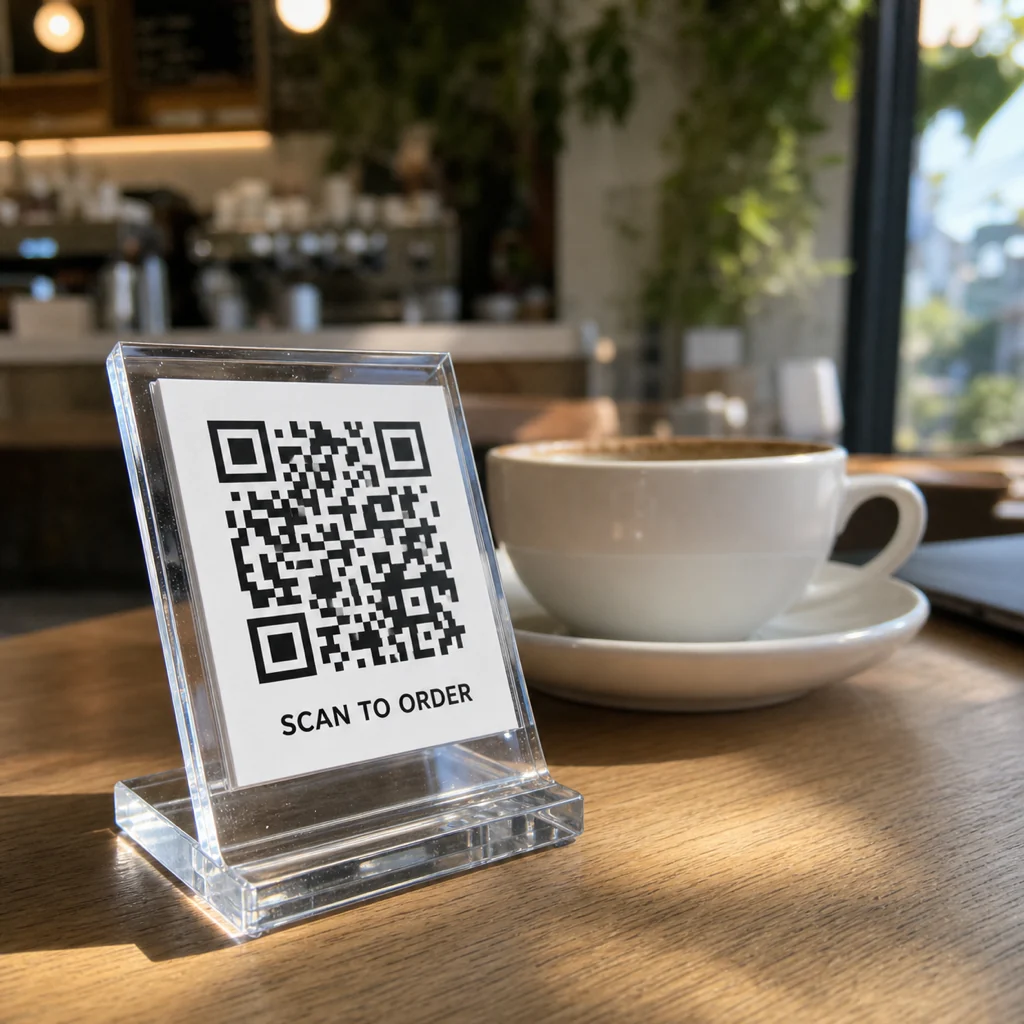
The golden unit should be tested with the actual label stock, not a screen mockup. Check edge lift, removal, glare, viewing angle, print contrast and whether routine wiping disturbs the insert. A QR symbol in a product photograph is a format illustration only; scan performance depends on the final encoded artwork, print quality, size, quiet zone, lighting and destination page controlled by the buyer.
Can restaurants replace the QR code on the stand later?
Yes. A replaceable-code design can use a 52 × 52 mm recessed pocket sized around a 50 mm printed label. The buyer approves the label stock and pocket depth on the sample, then field teams can change merchant-specific codes without replacing the permanent branded stand.
How fast can a 1,000-plus unit custom QR stand order ship?
Wetop's standard plan is 3–5 days for a sample and 15–20 days for production after sample and artwork approval. A 1,000-plus unit run is scheduled by SKU, print setup and inspection cadence; the confirmed ex-factory date appears on the quote after capacity review.
Why silk-screen the platform logo but sticker the QR code?
Because they have opposite lifecycles. The platform logo is a stable artwork layer suited to screen printing, while the QR code may change by restaurant or merchant account. Keeping the code in a replaceable insert reduces variable-data matching risk and lets the buyer verify merchant identity during deployment.
Rolling out stands across hundreds of tables?
Send us your artwork, your target footprint, and your unit count — we'll come back with a DFM review, a recommendation on fixed print vs replaceable inserts, and a quote.
Sample in 3–5 days · Production in 15–20 days · MOQ 100 pieces