Vetting Acrylic Fabricators: Capacity Disclosure Before Your PO
A certificate confirms a management system; it does not show whether the CNC, polishing, bonding, and inspection capacity your project needs is actually available. This disclosure sheet turns capacity claims into project-specific questions.
Key Takeaways
- Ask for machine count, working shift pattern, the load already committed during your required window, and the stage that limits output. A useful answer ties each number to your SKU instead of quoting a theoretical factory maximum.
- Equipment depth matters more than equipment presence. The relevant question is whether the process your design needs has a workable backup plan if a machine or operator becomes unavailable.
- For repeat work, ask which approved drawings, CNC programs, jigs, fixtures, and samples are retained, for how long, and how the supplier verifies revision parity before reuse.
- Bottleneck stage is rarely cutting — it's polishing or QC. Ask which stage caps daily throughput; vague answers mean the fabricator hasn't done a capacity study and can't tell you what your rush order will actually cost in lead time.
- Sample and production lead times are different workflows. Wetop's registered baseline is 3–5 days for a paid pre-production sample and 15–20 days for production after approval, with transport added separately.
On this page
- The 4 numbers your fabricator should disclose without hesitation
- Machine inventory — why “we have CNC” isn’t enough
- Shift patterns + capacity utilization — peak vs steady-state
- Tooling library — the question that separates project shops from production shops
- Bottleneck identification — what to ask about the slowest stage
- Red flags — 3 supplier behaviors that predict missed deadlines
- Related guides
For acrylic fabricators, capacity becomes useful only when it is tied to a product and a date. A claim such as “we have plenty of capacity” cannot tell you which machine will cut the part, who will polish and assemble it, when inspection occurs, or what happens if the critical station becomes unavailable.
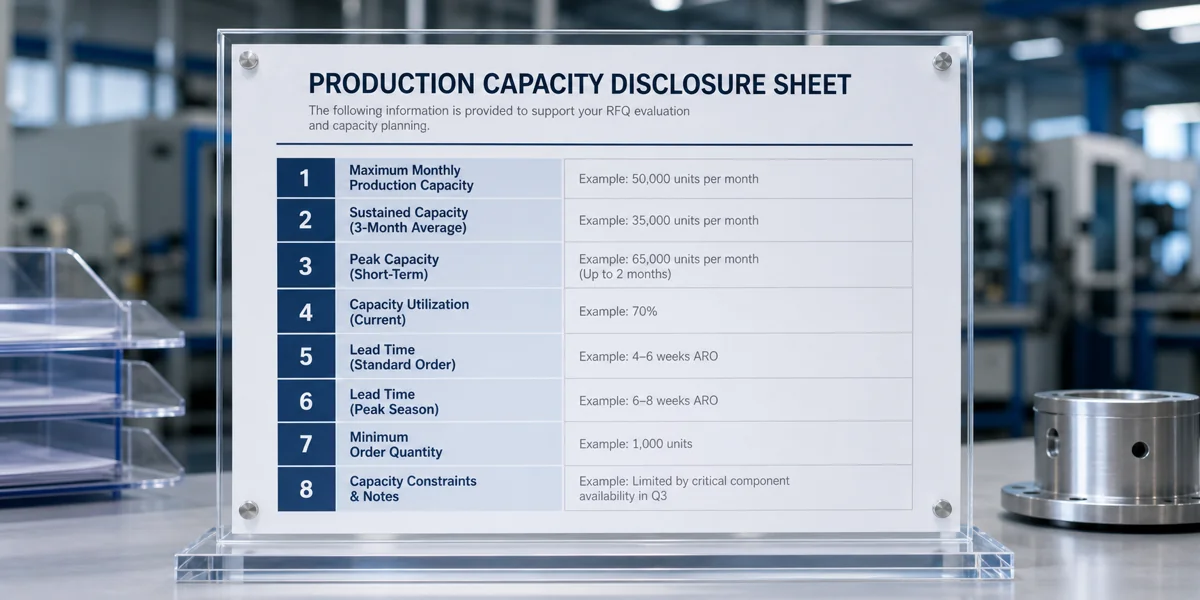
The framework below replaces that headline with eight questions. It works in both directions: buyers can compare candidates on the same evidence, and a fabricator can explain exactly how a project fits its operation without exposing another customer’s confidential order data.
If a buyer is sourcing custom acrylic and considering more than one factory, we recommend running this on the top three candidates before any PO. It takes 30 minutes per fabricator on a video call.
The 4 numbers your fabricator should disclose without hesitation
Every serious acrylic fabricator already tracks the four core capacity metrics for their own operations. ISO 9004:2018 lists capacity planning under sustained-success guidelines for exactly this reason — without measured capacity, a factory can’t price work, schedule deliveries, or detect overload before it becomes a slipped deadline.1
The four numbers are:
- Machine count by process. Not “we have CNC and laser” — a per-process inventory. Three CNC routers? Six? Twelve? Same for laser cutters, polishing stations, bonding tables, drill presses, edge buffers. The number tells you bottleneck depth. If a fabricator runs two CNC routers and one breaks during your job, you slip three days minimum.
- Shift pattern + committed load. Ask which working shift will run your parts and how much of the required window is already committed. A factory-wide utilization percentage is less useful than the load on the CNC, polishing, bonding, or printing process your SKU actually needs.
- Maximum daily output shipped this quarter, by product family. Theoretical max (“we can do 5,000 sign holders”) is marketing. Actual shipped (“our peak last quarter was 1,840 sign holders on March 18, verified against the shipping log”) is a number you can audit if you want to.
- Current order-book commitment for your required window. Ask what has already been scheduled on the same processes and which dates the supplier can reserve for your order. The commitment should appear in the quoted production plan rather than remain a verbal assurance.
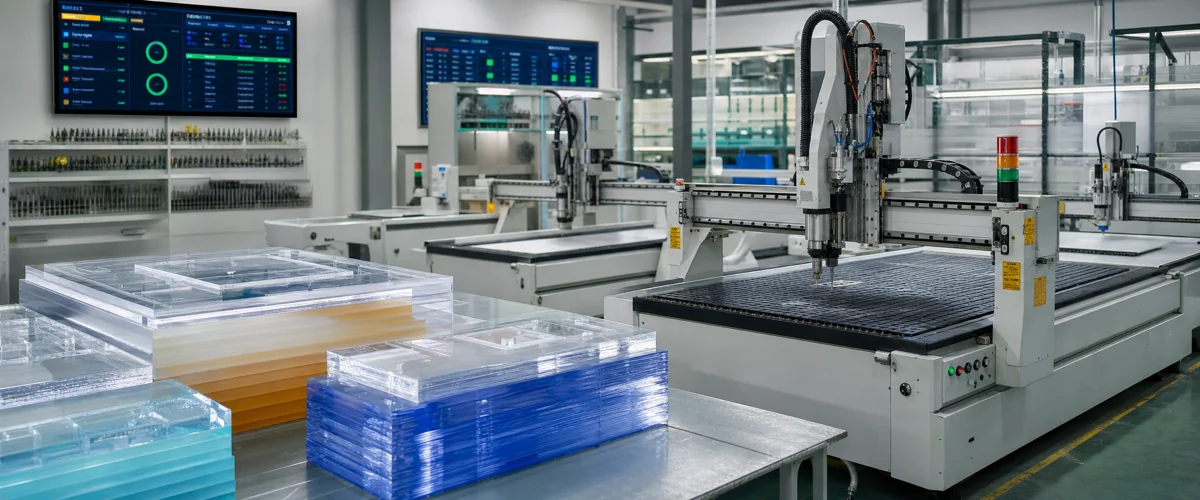
Wetop’s stable equipment disclosure is 4 CNC machines, 8 laser cutters, a dedicated diamond-polishing line, UV and silk-screen printing, thermoforming, bending, and assembly in a 5,000 m² Shenzhen facility. Utilization, daily output, and open capacity change with the order mix, so they should be answered against a specific drawing, quantity, finish, and requested date rather than published as permanent website numbers.
When a candidate hesitates on any of the four, we see two reasonable next moves: ask why (the answer often reveals whether you’re talking to a manufacturer or a sales office for one), or move on. There are too many capable acrylic fabricators in 2026 to spend audit time on an opaque one.
Machine inventory — why “we have CNC” isn’t enough
The most common capacity misrepresentation we audit out of new suppliers isn’t a missing machine. It’s machine depth that doesn’t survive a single breakdown.
Equipment depth means: how many of each machine the fabricator runs, what the per-machine duty cycle is, and what the redundancy plan looks like when a machine is down for maintenance or repair. The right way to think about it is single-point-of-failure analysis — the same logic insurance auditors use on factory operations.
When you vet acrylic fabricators on equipment depth, ask:
- CNC router count + brand + bed size. A shop with one 4’×8’ router and one 5’×10’ router has nominal CNC capacity but zero redundancy on either bed size. We look for at least two routers in the bed size that fits the buyer’s parts. Brand matters less than count, but mainstream brands (Multicam, AXYZ, Biesse, ShopSabre) are easier to service than off-brand machines that depend on a single technician.
- Laser cutter count + wattage + type (CO2 vs fiber). Acrylic cuts cleanly on CO2 lasers; fiber lasers handle metal hardware on lockable cases. A fabricator with one 150W CO2 has fragile capacity. Three 150W or one 250W plus a backup is real capacity.
- Polishing station count. This is the one most buyers forget. Polishing is hand labor — it doesn’t scale with one more machine, it scales with one more trained operator. A shop with six CNCs and two polishing stations has a polishing-bound throughput limit that won’t show up in their CNC capacity claim.
- Bonding/assembly stations. For complex assemblies — lockable cases, multi-piece displays, edge-lit signage — bonding is often the hidden bottleneck. Ask how many stations and whether they share a clean bonding environment (humidity-controlled, dust-extracted) vs. an open shop floor.
We’d rather a fabricator say “we run three CNCs, that’s our redundancy floor” than claim “unlimited CNC capacity.” The first answer is operational reality; the second is a sales pitch that breaks the first time something goes wrong.
Shift patterns + capacity utilization — peak vs steady-state
Shift pattern tells you how the fabricator absorbs demand spikes. A shop running one shift at 85% utilization is steady-state busy — your rush order has nowhere to go. A shop running two shifts at 65% has overflow capacity built into the operating model.
Both patterns can be legitimate. What we watch for is the mismatch between what the fabricator claims and how the shop actually runs.
The questions we ask:
- “What shift pattern are you running today, and have you run a different one in the last 12 months?” A fabricator that ran two shifts in Q4 and dropped to one in Q1 has demand cyclicality the buyer should know about — not a disqualifier, but it changes the lead-time math for a Q4 rush order.
- “What’s your current capacity utilization, by process?” Some processes (CNC) often run hotter than others (bonding) at any given week. We expect a per-process number, not a single shop-wide one.
- “What’s the highest peak utilization you’ve sustained for more than two weeks?” Sustained 95%+ utilization is a leading indicator of QC degradation — operators get tired, changeovers get rushed, and defect rate climbs. Honest fabricators will tell you the peak and what they did to recover from it.
- “Are any of your shifts on contractor or temporary labor?” Temp-shift QC discipline is rarely as consistent as core-shift discipline. For high-stakes orders we want to know which shift our parts will run on.
The practical risk is simple: when the critical process has no recovery path, an upstream delay can move every order behind it. Ask the supplier to explain the contingency in writing instead of relying on a universal utilization threshold.
Tooling library — the question that separates project shops from production shops
This is the question almost no buyer asks on a first call, and it’s the single biggest predictor of repeat-order economics.
A tooling library is the inventory of jigs, fixtures, CNC programs, bond-line templates, drill guides, and packaging molds the fabricator has built across past jobs. Project shops discard tooling after each order — your second order requires re-tooling, which is the same lead time and tooling cost as the first. Production shops archive tooling indexed against part numbers and customer accounts, which means your second order skips tooling entirely and goes straight to material cutting.
Retained tooling can reduce engineering setup on a repeat order, but it does not replace revision verification, material allocation, production, or inspection. Wetop’s registered production baseline remains 15–20 days after approval; any repeat-order reduction must be quoted for the actual retained files and fixtures.
Specific questions to ask any acrylic fabricator:
- “Which files, jigs, fixtures, approved samples, and packaging specifications from my order will you retain?” Ask for the list, not a headline library count.
- “What is the retention period for each item?” Put the agreed period in the PO or supply agreement instead of assuming an industry default.
- “How is each retained item tied to the approved revision?” The supplier should be able to identify the customer, part number, revision, and approval record.
- “What must be revalidated on a repeat order?” A responsible answer distinguishes reusable setup from material, artwork, dimension, finish, and inspection checks that must run again.
Tooling-library size alone is not a maturity score. A smaller archive can be appropriate for a focused product mix, while a large but poorly indexed archive may be unusable. Revision control and retrieval accuracy are the evidence that matter.
For tooling preservation in the broader manufacturer context, see our acrylic display manufacturer checklist, which extends this framework to certifications, traceability, and QC sampling.
Bottleneck identification — what to ask about the slowest stage
Every fabrication shop has a bottleneck — the stage that caps how fast the whole shop can ship. APICS supplier capacity assessment frameworks treat bottleneck identification as a core diligence step, because the bottleneck is what determines lead time when capacity is stressed, not the headline machine count.2
Most buyers start with cutting capacity, but cutting is only one possible constraint. Depending on the product, the limiting stage may be:
- Polishing. Hand labor. Doesn’t scale with another machine — only with another trained operator, and operator training takes 6–12 weeks. A shop with six CNCs and three polishers is polish-bound, and any rush order will queue at polishing.
- QC. A 100% inspection requirement caps released output at what the inspection team can verify, regardless of how fast cutting and bonding run.
- Bonding cure time. UV bonding for high-clarity joints requires 4–8 hours of cure time depending on the chemistry. The bonding station count matters less than the cure-time queue management. A fabricator running 24-hour batched cure cycles has a 24-hour minimum lead-time floor on any bonded assembly.
- Packaging. Custom B2B parts often need custom packaging — die-cut foam, branded sleeves, retail-ready cartons. A shop that outsources packaging adds 3–5 days of external lead time that doesn’t show up on the production schedule.
The right question is direct: “Which stage caps your daily throughput, and what’s the daily output of that stage?” A fabricator that knows the answer has done a capacity study. One that says “everything’s about the same” hasn’t, and won’t be able to give you a credible lead-time commitment when the shop is stressed.
Ask the supplier to identify the limiting stage for your product, show how its cycle time was included in the quoted 15–20-day production plan, and state what would change that date. This keeps the answer project-specific and auditable.
For a recent example of how bottleneck-aware capacity disclosure shaped a multi-shipment program, see our automotive showroom countertop displays case study.
Red flags — 3 supplier behaviors that predict missed deadlines
Since founding Wetop in 2008, I have learned to treat three answer patterns as reasons for deeper verification, not as proof by themselves.
- Capacity numbers that change between calls. First call: “we have 4 CNCs running two shifts.” Second call (after the buyer pushes on lead time): “we have 6 CNCs and we’ll add a third shift for your job.” Real capacity is determined by physical machines and trained operators, not by how badly the fabricator wants the order. When numbers grow under pressure, the underlying numbers were never real to begin with.
- Lead times that shrink as the buyer asks more questions. “21 working days” becomes “we can probably do 17” becomes “we’ll prioritize you, 14 days” within a single call. A real lead time is a function of tooling, capacity, and material lead — not buyer-relationship vibes. When a fabricator compresses the quote 33% across one phone call, what they’re telling you is that the original number had no operational basis.
- “We can handle any volume” without specifics. Every operations team has a peak volume they’ve actually hit and a ceiling they haven’t crossed. Fabricators who claim infinite capacity are either reselling other factories’ work without telling you, or they don’t measure capacity at all. Both are disqualifiers for any order over five figures.
A subtler red flag is a fabricator that will recite capacity verbally but will not bind the process route and production window to the quote. Written dates and responsibilities are auditable; a sales-call assurance is not. To see these capacity and QC checks applied to a single product category at rollout scale, our acrylic standee manufacturer verification guide walks the same logic through a retail standee program.
If a buyer wants to run this framework on us — which is fair, since I recommend running it on every candidate — see our process and quality documentation, browse our acrylic displays product range for production scope, or send the drawing, quantity, finish, and required date to our team via the capacity-vetting intake. We will answer with the registered facility and equipment facts, then quote the project-specific production window in writing.
Related guides
- China vs USA Acrylic Fabricator: 6 Tradeoffs Buyers Miss
- Why China-Based Acrylic Suppliers Get Audited Twice — and How We Pass
Footnotes
-
International Organization for Standardization. ISO 9004:2018 — Quality management — Quality of an organization — Guidance to achieve sustained success. Published 2018-04. https://www.iso.org/standard/70397.html ↩
-
Association for Supply Chain Management (formerly APICS). Certified Supply Chain Professional (CSCP) Learning System — Module 4: Supplier Relationships and Capacity Assessment. Reference framework for capacity diligence. https://www.ascm.org/learning-development/certifications-credentials/cscp/ ↩
Frequently Asked Questions
What's the difference between an acrylic fabricator's quoted capacity and actual capacity?
Quoted capacity is usually a theoretical maximum. Available capacity is the equipment, finishing labor, inspection time, and production window the supplier can reserve for your actual SKU. Ask which processes constrain the order, what is already committed during your required dates, and what contingency applies if a critical station becomes unavailable.
How many CNC routers should an acrylic fabricator have to handle a $100k order?
There is no responsible machine-count threshold based on order value alone. The answer depends on part size, cycle time, material, finishing, quantity, and the required dates. Ask the supplier to name the CNC bed and finishing path for your parts, then explain the backup plan for the critical process.
What's the right way to ask about capacity utilization without sounding nosy?
Frame it as a delivery-risk question: 'Which processes will this order use, what is already committed during our required window, and what production dates can you reserve in writing?' That request is more useful than asking for a single factory-wide utilization percentage because it binds capacity to your SKU and deadline.
Do I need to visit the factory in person to verify acrylic fabricators' capacity claims?
Use the verification level that matches the order's operational risk. A live video walkthrough can confirm equipment and workflow; a site visit or independent audit adds stronger evidence when continuity, regulation, or launch timing makes failure costly. Scope the audit to your product and required processes instead of choosing it from an unsupported order-value threshold.
What if an acrylic fabricator refuses to disclose machine count or shift pattern?
Treat a refusal as missing evidence, not proof of a specific hidden problem. Ask whether the supplier can disclose the process route, responsible facility, reserved window, and contingency without exposing confidential customer data. If it cannot provide enough information to assess delivery risk, keep the candidate unqualified until that gap is closed.
Want our capacity disclosure sheet on your project?
Send the product drawing, quantity, finish, approval deadline, and in-hand date. We will map the job against our registered equipment — 8 laser cutters, 4 CNC machines, diamond polishing, printing, bending, thermoforming, and assembly — and quote the production window that applies to the project.